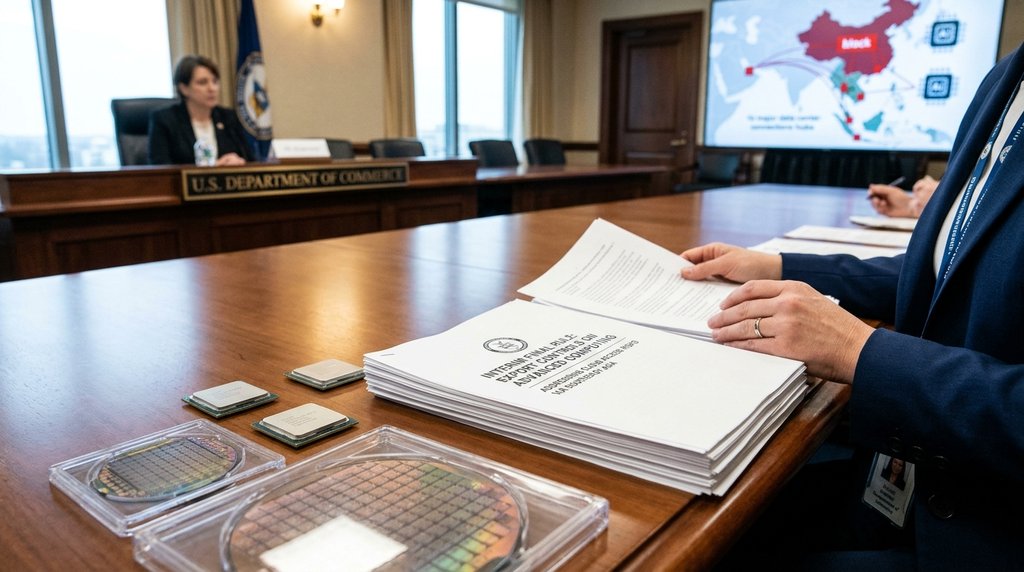
The US Department of Commerce Bureau of Industry and Security has released a 132-page interim final rule designed to prevent entities in China and other arms-embargoed jurisdictions from remotely accessing high-performance computing power. Under the new framework, global data centers must obtain US government authorization before supplying compute capacity exceeding a Total Processing Performance threshold of 12 million to companies headquartered in China, Macau, or other covered nations. This threshold represents roughly 750 Nvidia H100 or H200 accelerators, directly targeting the high-capacity infrastructure required to train commercial frontier artificial intelligence models. The policy follows growing scrutiny in Washington over regulatory loopholes, amplified by controversies involving Singapore-based cloud provider Megaspeed, with lawmakers noting that the rules directly target pathways previously exploited to circumvent chip export bans.
Crafted under direction from the US Treasury Department and the National Security Council, the new measure formally scraps an earlier AI framework introduced under the Biden administration. In its official notice, the Bureau of Industry and Security explained that the rule aims to eliminate workarounds where third-country facilities host American hardware to provide prohibited capabilities over network connections. The policy effectively equates remote digital access to physical exports and re-exports, establishing that compute rented across national borders remains subject to strict US trade jurisdiction. As part of the rollout, authorities specifically designated Brazil, Indonesia, Malaysia, Singapore, and Thailand as diversion-risk jurisdictions, requiring dedicated government licenses for exporting, re-exporting, or transferring advanced artificial intelligence semiconductors to those regions.
Over the next six months, cloud platforms and hyperscale data center operators will encounter intense pressure to restructure operations across key global computing hubs. The Commerce Department has granted an initial 90-day grace period, compelling local hosting firms and chip suppliers like Nvidia to review customer portfolios and confirm beneficial ownership structures. These requirements impose rigorous due-diligence burdens on facilities in Southeast Asia, where global tech firms have recently expanded infrastructure at a rapid pace. Projects relying on Chinese capital or third-party corporate entities face imminent licensing scrutiny, which analysts anticipate will substantially reshape cross-border infrastructure investment, compute allocation, and commercial leasing arrangements worldwide.