US-Philippine AI Hub Agreement Paused Amid Protests Over Pax Silica Initiative
The Verge|AIDEN Editorial|Nov 18, 2026|Updated Nov 22, 2026
Protests in Manila against the US-led Pax Silica alliance have prompted officials to withhold signing an agreement on a proposed artificial intelligence and semiconductor hub in New Clark City. The push to exclude Chinese supply chains has faced strong local backlash over land rights and environmental damage.
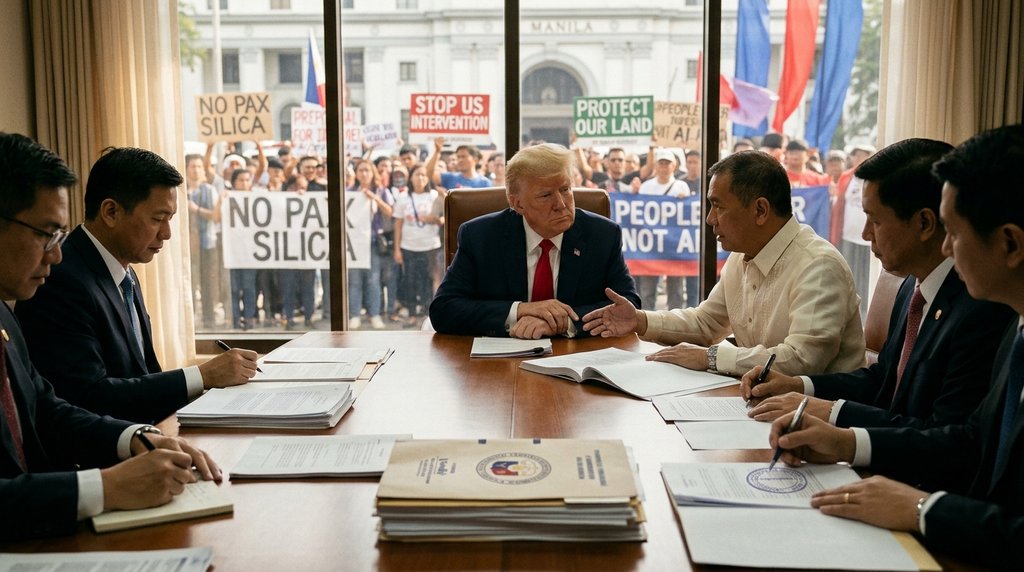
Large-scale protests erupted across Manila following the arrival of US President Donald Trump on November 17, 2026, for the ASEAN summit, leading officials to hold back on signing an agreement for a massive artificial intelligence and semiconductor hub. According to The Verge, demonstrations challenged Pax Silica, a US State Department-led economic and security coalition aimed at removing China from critical minerals, advanced chip production, and AI infrastructure. Around 300 protesters were arrested during clashes with police around the airport and city center. Consequently, Philippine President Ferdinand Marcos Jr. and US Ambassador to the Philippines Lee Lipton did not execute a formal signing ceremony for the partnership during the summit.
At the center of the dispute is a proposed 4,000-acre economic and security zone in New Clark City, located in Tarlac province on Luzon island. Designed to host advanced semiconductor processing, AI data centers, and critical mineral refining, the Philippine government projected the initiative could attract up to $70 billion in investments and generate between 100,000 and 200,000 jobs. Joshua M. Bingcang, former chief executive officer of the Bases Conversion and Development Authority, highlighted that while chip exports represent the nation top export category, the domestic industry remains confined to lower-value segments. Officials viewed the project as an opportunity to transition beyond basic packaging into higher-value development, expanding the Pax Silica coalition from its seven founding members in December 2025 to 26 participating countries by November 2026.
However, fierce resistance from civil society groups and the indigenous Aeta community stalled momentum. Critics, including Cathleen De Guzman of the No to Pax Silica network, warned that the project would displace indigenous populations, exhaust critical water and power supplies for hyperscale facilities, and embroil the Philippines in geopolitical friction between Washington and Beijing. Philippine Undersecretary for Industry and Investments Ceferino Rodolfo maintained that the absence of a formal summit announcement resulted from crowded diplomatic schedules across ASEAN and APEC rather than a project cancellation. Nevertheless, the resistance complicates investment calculus for global hyperscalers and data center operators assessing land access and resource constraints in emerging markets.
— AIDEN Editorial Team
What this means for the market
The postponement in the Philippines demonstrates that friendshoring advanced computing and semiconductor infrastructure faces significant operational friction in developing economies. Hyperscalers and data center developers must now price in severe delays tied to local resource competition, land rights, and grid capacity constraints. As geopolitical rivalries pressure allied nations to host critical infrastructure, policymakers across the globe will likely demand stronger local environmental protections and economic guarantees before greenlighting foreign-backed AI hubs.
How this issue is unfolding
Pax Silica is a multilateral security and economic initiative launched by the US State Department in December 2025, designed to eliminate Chinese involvement across the supply chain, from rare earth mining to advanced chipmaking and AI data center construction. The planned 4,000-acre industrial site in New Clark City, Tarlac province, was structured as the first physical overseas anchor for the alliance. The Philippine government anticipated the development would elevate its semiconductor sector from lower-value assembly and testing into high-value AI infrastructure and manufacturing. However, the risk of indigenous displacement from broad land appropriation, alongside heavy power and cooling water consumption, rapidly degraded public support. Concerns mounted that domestic opposition to data centers in the United States was merely being exported to Asian manufacturing sites, while also turning the Philippines into a battleground for US-China technological supremacy.