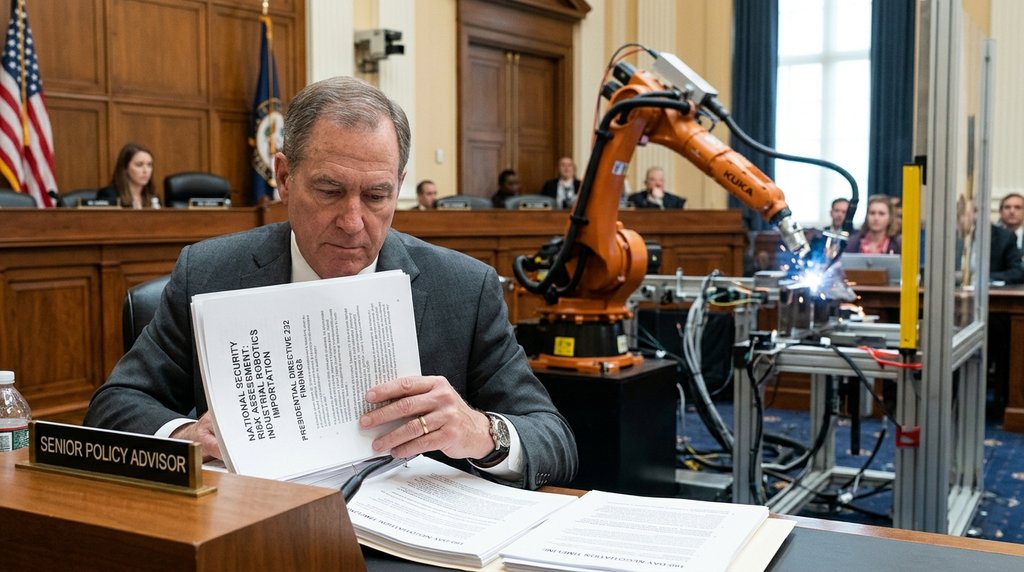
US declares robot imports a national security threat and opens trade talks
Ars Technica|AIDEN Editorial|Oct 29, 2026
President Donald Trump has declared imports of industrial robots and machinery a threat to national security, citing heavy reliance on foreign equipment across defense and critical manufacturing. Rather than issuing immediate penalties, the White House established a 180-day negotiation window with trading partners before considering potential tariffs or quotas.
On October 28, 2026, President Donald Trump issued a presidential proclamation designating foreign-made industrial robots, machinery, and parts as threats to national security under Section 232 of the Trade Expansion Act. The move followed a 13-month investigation initiated by the Department of Commerce in September 2025. According to findings presented by Commerce Secretary Howard Lutnick, an extreme shortfall in domestic manufacturing capacity has left the country dependent on imports, imperiling the domestic industrial base, long-term national competitiveness, and critical infrastructure cybersecurity. Rather than imposing immediate punitive duties, the administration directed Lutnick and United States Trade Representative Jamieson Greer to open formal negotiations with key trading partners, setting a 180-day timeline before further actions such as tariffs or quotas are finalized.
This policy extends national security trade reviews, historically aimed at basic commodities like steel and aluminum, into modern automated manufacturing hardware and operational data security. Federal investigators warned that critical manufacturing facilities and defense contractor lines are excessively tied to overseas machinery, creating severe vulnerabilities to data theft and remote tampering. Although the United States deployed approximately 38,500 industrial robots in 2025 as the second-largest adopter globally, domestic alternatives for core automated hardware remain virtually nonexistent. Industrial reliance on foreign suppliers for heavy-payload robotic arms sits near 100 percent, exposing a stark divide between government reshoring ambitions and the current operational reality of American factory floors.
The American advanced manufacturing landscape depends heavily on four major international suppliers: Japan-based FANUC and Yaskawa, Switzerland-based ABB, and KUKA, which is tied to German and Chinese capital. Automakers such as General Motors, Ford, and Tesla, alongside defense and aerospace giants like Boeing and Lockheed Martin, rely on these four companies for assembly-line robotics. The 180-day negotiation grace period acts as a buffer against sudden equipment shortages and capital cost spikes that could stall new factory construction. If negotiations fail to yield agreements, impending measures including import quotas, supplemental fees, and tariffs will threaten vehicle and defense expansion budgets, likely forcing foreign automation giants to explore domestic joint ventures or factory investments inside the United States.
— AIDEN Editorial Team
What this means for the market
The classification of automation machinery as a national security risk signals that hardware supply chains are now inseparable from broader digital sovereignty debates. As robotics and artificial intelligence converge on factory floors, reliance on foreign-built industrial arms creates strategic and cybersecurity liabilities for advanced economies. Global automation vendors will face mounting pressure to localize manufacturing footprints or enter domestic partnerships, reshaping the economics of high-tech production worldwide.
How this issue is unfolding
The United States Department of Commerce initiated an investigation under Section 232 of the Trade Expansion Act in September 2025 to examine the national security impacts of robot and industrial machinery imports. Concluding after roughly a year, the inquiry found that major defense production lines and critical infrastructure facilities depend excessively on foreign hardware, presenting vulnerabilities including sensitive data leakage and unauthorized remote control. While the Trump administration seeks to revitalize domestic manufacturing across automotive, aerospace, and battery sectors, factory automation hardware remains heavily dominated by four foreign manufacturers: FANUC, ABB, Yaskawa, and KUKA. Granting a 180-day negotiation window instead of immediate tariffs serves as a compromise to temporarily avert supply chain disruption and surging capital equipment costs for domestic manufacturers. If these negotiations culminate in import quotas or punitive duties, automakers including Ford, GM, and Tesla will likely face delivery delays and higher investment expenditures for new and expanding factory lines.