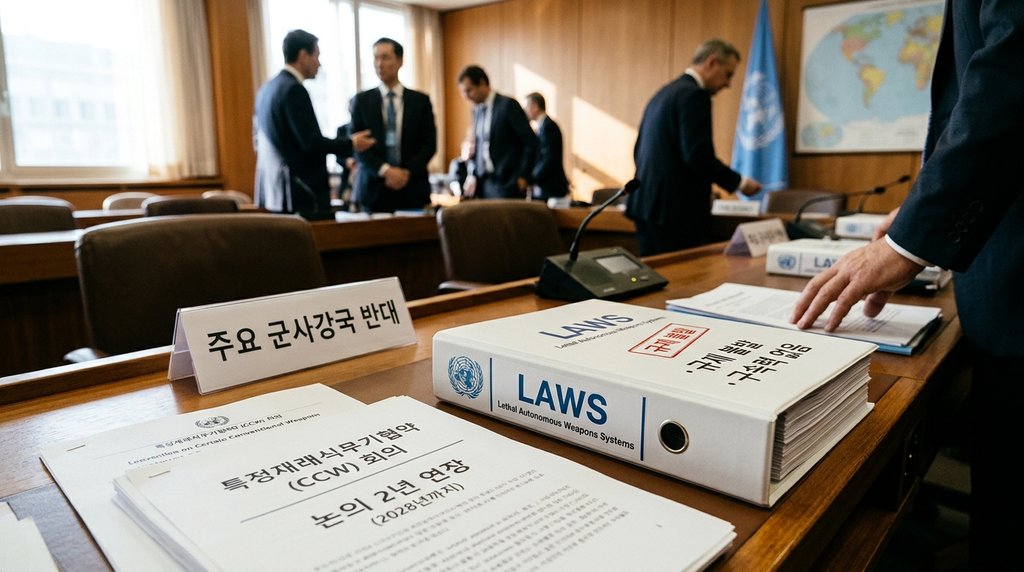
Delegates representing 128 member states at the Seventh Review Conference of the United Nations Convention on Certain Conventional Weapons in Geneva concluded an overnight diplomatic session without establishing binding limits on lethal autonomous weapons systems. Despite mounting concern over algorithmic targeting and semi-autonomous drone deployments in conflict zones such as Ukraine, Gaza, and Sudan, the conference ended with a weak compromise that merely extends informal discussions to elaborate regulatory options through 2028. The International Committee of the Red Cross and UN Secretary-General António Guterres, supported by roughly 100 nations, had urged negotiators to establish a legally enforceable treaty within one year. However, strong resistance from major military powers, notably the United States and Russia, blocked the formal mandate to negotiate, prompting civil society organizations like the Campaign to Stop Killer Robots to warn that the resulting regulatory void will accelerate risks to civilians.
The diplomatic stalemate highlights a stark divergence between civilian and military artificial intelligence governance. While civilian oversight frameworks such as the European Union AI Act and executive measures in the United States increasingly mandate strict risk management and human supervision over high-risk applications, security frameworks remain entirely stalled. Defending their opposition, nations including the United States, Russia, and Israel maintained that existing international humanitarian law provides sufficient coverage, resisting multilateral caps that might curtail their strategic defense capabilities. Under the convention's consensus-based rules, military powers leveraged procedural tactics to dilute the final text, expelling explicit terms that authorized formal treaty negotiations in favor of vague wording around developing policy options.
The regulatory delay offers defense contractors and military research divisions a multi-year window to accelerate autonomous targeting and drone swarms without legal restrictions. While Swiss Ambassador Julien Thöni, who led the proceedings, framed the outcome as evidence that multilateral diplomacy could still forge consensus amid geopolitical tension, outside observers sharply condemned the retreat. Max Tegmark, a professor at the Massachusetts Institute of Technology and founder of the Future of Life Institute, criticized governments for choosing to prolong 14 years of unresolved discussions while autonomous armaments proliferate. Concurrently, Georgia Hinds, a legal adviser for the International Committee of the Red Cross, warned that allowing automated software and algorithmic mechanisms to make life-and-death targeting choices crosses a critical moral boundary that technological advancement cannot justify.