Meta and Apple optimize massive open-weight AI model for Mac desktops
TechCrunch|AIDEN Editorial|Oct 15, 2026
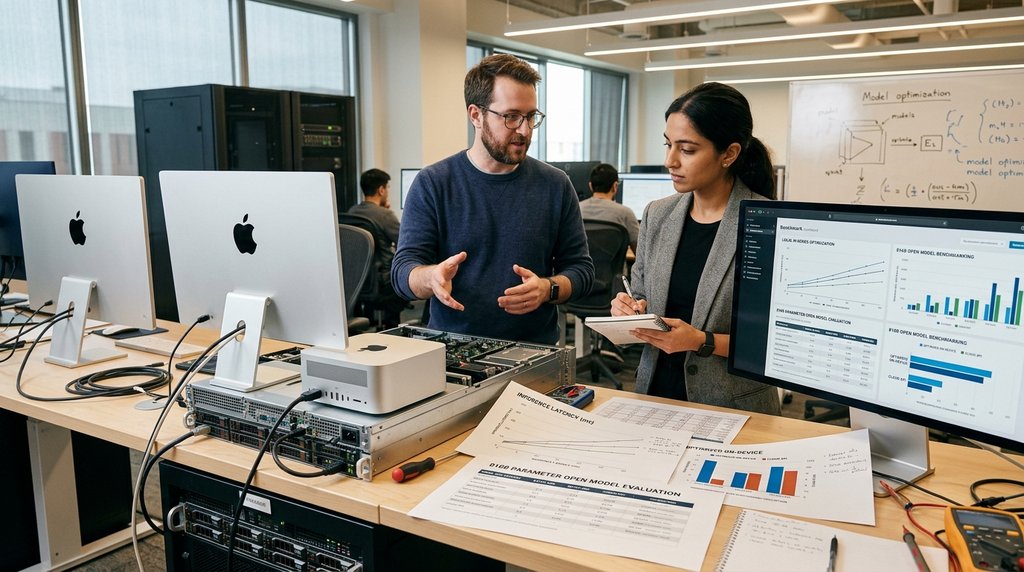
Meta has released Muse Spark Open, an 816-billion-parameter open-weight model optimized in partnership with Apple to run locally on Mac Studio workstations. The system requires paired M5 Ultra chips with 1TB of unified memory, offering enterprises an on-premises alternative to hosted cloud APIs.
Meta has released Muse Spark Open, an open-weight artificial intelligence model featuring 816 billion total parameters and 42 billion active parameters. According to TechCrunch, the architecture supports a context window of one million tokens and is optimized to run locally on Mac desktops via Apple’s open-source MLX machine learning framework. The technical deployment pairs two Mac Studio systems equipped with Apple’s M5 Ultra processor, pooling 1TB of unified memory over Thunderbolt RDMA. Meta Chief AI Officer Alexandr Wang credited Daniel Gross, a former Apple executive now at Meta, with facilitating the technical collaboration between the two long-standing industry rivals. Apple Senior Vice President John Ternus noted on social media that running a model of this magnitude efficiently on desktop hardware expands the operational boundaries of on-device artificial intelligence.
The system marks a substantial hardware escalation from lightweight local predecessors like Muse Glimmer, which was released in August 2026 for single-computer environments. To handle the 42-billion active Mixture-of-Experts architecture, Muse Spark Open requires at least two interconnected M5 Ultra systems, while scaling to a four-unit cluster increases inference speeds to more than 36 tokens per second. Meta is distributing the model weights through Hugging Face, Amazon SageMaker AI, and Google Cloud Model Garden under licensing terms that allow restricted commercial use. Wang told Bloomberg that most global artificial intelligence will ultimately operate on open-weight foundations and that American developers must maintain leadership over competing Chinese offerings such as GLM and Kimi.
The deployment alters infrastructure planning for engineering teams weighing cloud operational expenses against dedicated on-premises hardware. While building a multi-unit Mac Studio cluster represents an initial capital outlay of tens of thousands of dollars, it eliminates recurring pay-per-token API fees and mitigates data leakage risks for proprietary codebases. By delivering real-time inference speeds alongside a million-token context window within closed enterprise local networks, the system establishes high-end personal workstations as a viable total-cost-of-ownership alternative to centralized data centers for frontier-tier machine learning workloads.
— AIDEN Editorial Team
What this means for the market
The release shifts high-end artificial intelligence infrastructure economics by demonstrating that frontier-scale open-weight architectures can run reliably on clustered desktop hardware outside traditional cloud data centers. For global engineering teams handling proprietary IP and regulated information, fixed-cost workstation clusters provide an operational alternative to continuous per-token cloud bills and third-party data transmission. Furthermore, the collaboration illustrates how Western technology leaders are leveraging accessible open-weight ecosystems and unified-memory silicon to counter the expanding influence of Chinese open models.
How this issue is unfolding
Meta and Apple, historically divided over data privacy policies and App Store commissions, have partnered around the local execution of high-performance open-weight models. This alliance reflects aligned incentives between Meta’s strategy to decentralize frontier-class artificial intelligence away from cloud APIs into an open ecosystem, and Apple’s ambition to establish Mac silicon with high unified memory as standard enterprise workstations. Meta has explicitly positioned the release to retain Western dominance over open-weight models against Chinese alternatives like GLM and Kimi. Despite cluster acquisition costs running into tens of thousands of dollars, the setup is anticipated to accelerate enterprise adoption among engineering teams seeking to process sensitive internal data and source code entirely on-premise without exposing assets to external cloud services.