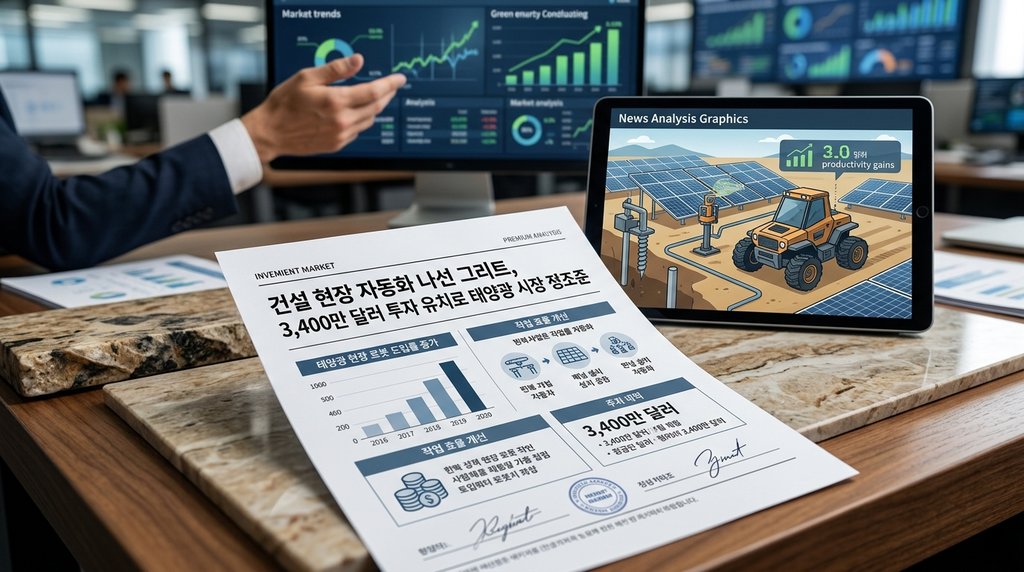
Robotics startup Gritt has emerged from stealth mode, announcing $34 million in funding to develop automation solutions for challenging construction tasks. The company plans to initially focus its efforts on streamlining the building of solar power plants.
Gritt, a new player in construction automation, has officially exited stealth, revealing $34 million in funding. The company aims to deploy advanced robotics to tackle some of the most demanding and labor-intensive tasks found on construction sites, with an initial strategic focus on the development of solar power plants. This investment signals growing confidence in the potential for AI-driven robotics to transform traditional industries facing significant operational hurdles.
The construction sector globally has long grappled with persistent challenges, including labor shortages, safety concerns, and inefficiencies that hinder productivity. Large-scale infrastructure projects, such as the construction of solar farms, often involve repetitive, physically demanding, and hazardous work, making them prime candidates for automation. The integration of robotics and artificial intelligence in these environments offers a pathway to mitigate these issues, enhancing both worker safety and project timelines. This move by Gritt aligns with a broader industry trend towards leveraging AI and automation to address critical bottlenecks in sectors vital for global development and sustainability.
The successful deployment of Gritt's robotic solutions could significantly accelerate the construction of renewable energy infrastructure, a crucial step in the global transition towards sustainable power sources. By automating repetitive and dangerous tasks, these technologies can free up human workers for more complex roles, improve overall site safety, and potentially reduce project costs and timelines. Beyond solar plants, the underlying robotic and AI technologies developed by Gritt could eventually be adapted for a wide array of construction applications, driving a more comprehensive digital transformation across the entire industry. This development underscores the increasing role of specialized AI applications in addressing real-world industrial challenges and fostering innovation in traditionally slow-to-adapt sectors.
— AIDEN Editorial Team · Reviewed by 이현민
What this means for the market
This development highlights the increasing specialization of AI and robotics in addressing specific industrial pain points. For the global AI market, it signifies a growing investment trend in physical AI applications beyond software, particularly in sectors like construction that have historically lagged in digital transformation. Developers will see increased demand for robust, adaptable AI systems capable of operating in unstructured, dynamic environments, pushing innovation in areas like computer vision, reinforcement learning, and human-robot collaboration. Policy discussions may increasingly focus on the future of work in automated industries and the need for reskilling initiatives.
How this issue is unfolding
The construction industry has long faced challenges such as labor shortages, safety concerns, and low productivity. Large-scale projects, particularly solar power plant construction, involve numerous repetitive and arduous tasks, underscoring the critical need for automation. Robotic automation solutions from companies like Gritt have the potential to resolve these issues, significantly improving efficiency and safety on construction sites. This innovation could become a vital catalyst for overcoming bottlenecks in building solar power infrastructure, accelerating the global shift towards renewable energy, and ultimately driving the digital transformation of the broader construction sector.