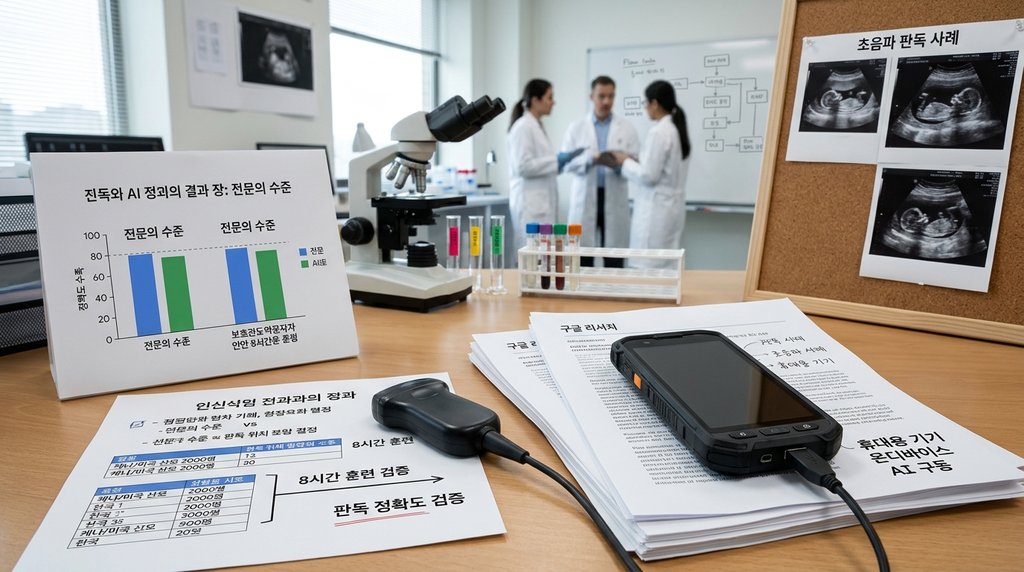
Google Research engineer Angelica Willis and Nichole Young-Lin, clinical lead at Google for Health, announced on October 21, 2026, the findings of a multi-site prospective clinical study demonstrating on-device artificial intelligence for non-expert ultrasound operators. The system pairs a low-cost, smartphone-connected ultrasound probe with an automated blind sweep protocol, requiring field staff simply to guide the probe across the abdomen. According to the Google Research official blog, the initiative aims to shift reliance away from expensive centralized diagnostic consoles and constant external cloud connectivity toward lightweight, point-of-care infrastructure.
According to the World Health Organization, two-thirds of the global population lacks access to diagnostic imaging such as ultrasound, while more than 250,000 preventable pregnancy-related deaths occur each year. Conventional obstetric ultrasound requires large machines and roughly two years—approximately 17,520 hours—of specialized sonographer training to locate precise anatomical planes manually. In contrast, Google standard sweep approach allows frontline workers with no prior equipment experience to deploy the system after approximately eight hours of foundational instruction. If an operator deviates from the sweep path or produces low-quality images, the on-device AI provides immediate prompts to rescan, maintaining consistent data capture.
Clinical validation spanned two continents with vastly different operational environments, collecting data from 1,000 pregnant women in Nairobi through Kenyan nonprofit Jacaranda Health and 1,000 women in Chicago through Northwestern Medicine. The local model matched fully trained sonographers in determining gestational age and fetal presentation, even in completely offline settings without inference latency. The system currently focuses on those two critical metrics and cannot detect complex abnormalities such as fetal malformations or placental conditions. Nevertheless, eliminating recurring cloud API charges, data transmission delays, and connectivity dependencies lowers deployment barriers for resource-constrained clinics seeking decentralized diagnostic tools.