Google Research unveils cuffless smartwatch AI model for detecting hypertension
Google Research|AIDEN Editorial|Nov 05, 2026
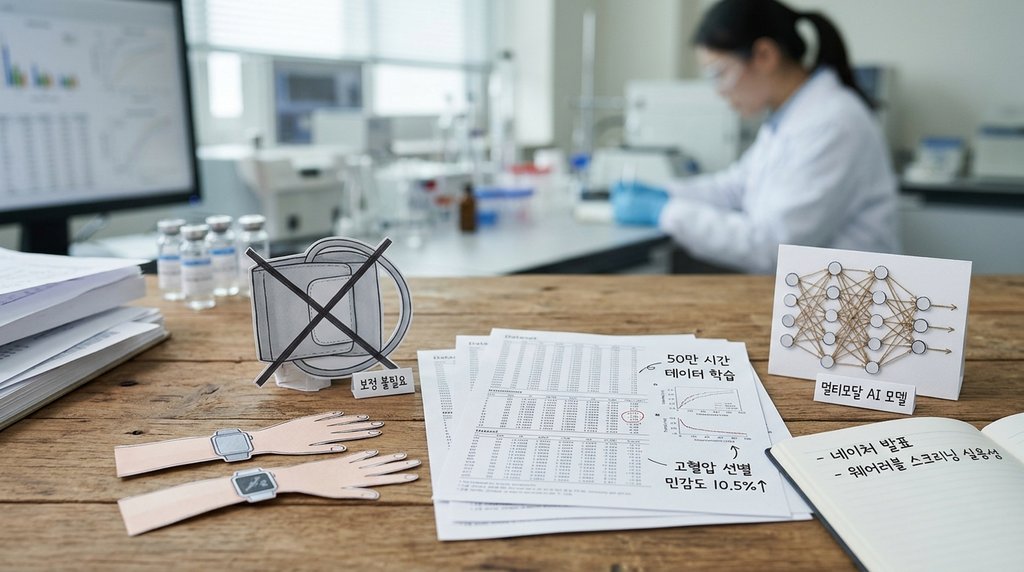
Google Research has developed an AI model that screens for hypertension signs using standard smartwatch sensors without cuff-based calibration. Published in Nature, the system uses multimodal time-series data to improve screening sensitivity by 10.5 percentage points over single in-clinic measurements.
Google Research scientists Paolo Di Achille and Mingzhe Po have introduced AI-PPG-ACC-HTN, a multimodal artificial intelligence system capable of detecting signs of hypertension using standard smartwatch sensors without requiring upper-arm cuff calibration. Published in the journal Nature, the study addresses a critical operational barrier in consumer health wearables, which have traditionally relied on frequent recalibration against inflated cuffs to maintain measurement baseline accuracy. By integrating photoplethysmography and accelerometer data, the researchers designed an algorithmic pipeline that directly estimates arterial stiffness and pulse dynamics while removing physical motion artifacts from everyday activities.
The underlying model was trained on roughly 500,000 hours of continuous pulse and acceleration waveforms. To validate its real-world diagnostic performance, researchers conducted a prospective multicenter evaluation with 196 participants who had no prior cardiovascular history or blood-pressure medication usage, using 24-hour ambulatory blood pressure monitoring as the clinical ground truth. During a seven-day monitoring trial, the model achieved a sensitivity of 65.8 percent, a specificity of 90.0 percent, and a positive predictive value of 80.6 percent. This outperformed standard single in-clinic screening, which showed a sensitivity of 55.3 percent and a positive predictive value of 77.8 percent while matching the same 90.0 percent specificity benchmark.
In a secondary confirmation analysis evaluating 48 individuals flagged for suspected hypertension during initial clinic visits, the AI model attained a positive predictive value of 96.7 percent alongside a sensitivity of 78.4 percent and a specificity of 90.9 percent. This exceeded repeat in-clinic cuff visits, which showed an 86.2 percent positive predictive value, as well as multi-day home cuff tracking at 94.3 percent. The authors emphasized that the technology is intended as a passive screening tool rather than a standalone diagnostic replacement for medical cuffs, aiming to identify asymptomatic individuals in everyday life and refer them to formal clinical evaluation before complications emerge.
— AIDEN Editorial Team
What this means for the market
By eliminating recurring physical calibration, this multimodal wearable architecture establishes a practical path toward widespread, passive cardiovascular monitoring across consumer electronics. For AI developers and health platform providers, training models on massive time-series sensor streams validates how multi-sensor fusion can overcome movement noise in uncontrolled consumer environments. The demonstrated positive predictive values may also assist healthcare policymakers looking to lower systemic screening costs by funneling high-risk, undiagnosed individuals into preventative medical care.
How this issue is unfolding
More than one billion people worldwide live with hypertension, yet over half of affected adults remain unaware of their condition due to an absence of overt early symptoms. Existing blood pressure features in commercial smartwatches have faced operational friction because they require periodic baseline recalibration with traditional inflatable cuffs, limiting their utility for sustained population-scale tracking. Google researchers addressed this bottleneck by training deep learning algorithms on 500,000 hours of pulse wave and accelerometer readings to assess arterial stiffness and pulse waveform patterns without manual calibration. The authors noted that the system is designed to serve as an early screening aid to channel asymptomatic individuals toward clinical validation, rather than operating as an outright replacement or definitive diagnostic device.