Google Research introduces DeepCrossAttention to speed up transformer training threefold
Google Research|AIDEN Editorial|Nov 23, 2026
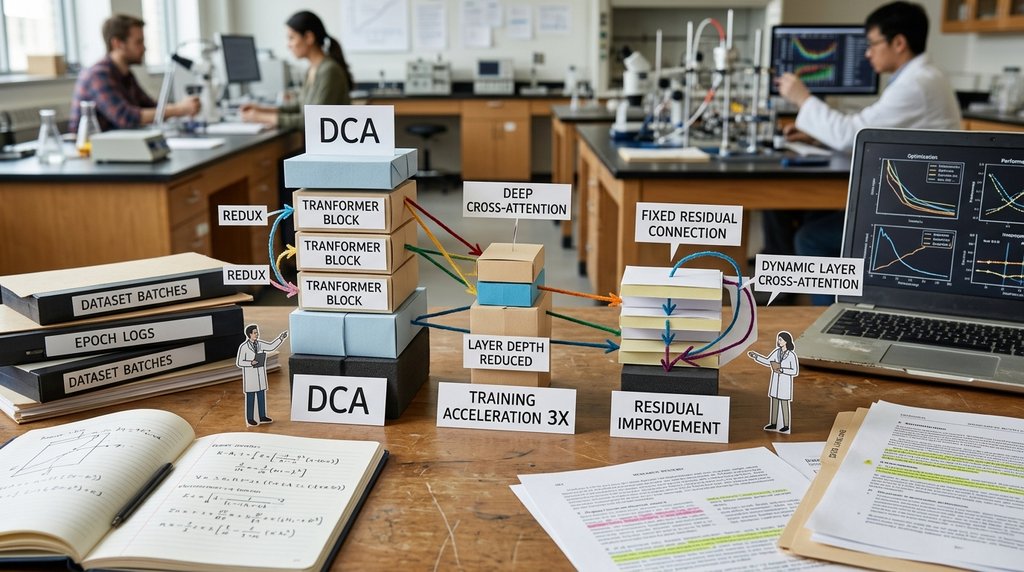
Google Research has unveiled DeepCrossAttention, an architectural update replacing standard residual connections in transformers with dynamic cross-layer attention. The technique cuts training steps by up to fivefold and accelerates learning speeds up to three times while adding less than 0.2 percent parameter overhead. The method also reduces necessary model depth by roughly 29 percent, providing substantial compute and latency savings.
Google Research scientists Kyriakos Axiotis and Thomas Fu have unveiled DeepCrossAttention, a novel architecture designed to overhaul the standard residual connections used in transformer models. First popularized by ResNet in 2015, residual connections use basic point-wise addition to combine previous layer outputs and prevent vanishing gradients. However, as foundation models scale into dozens or hundreds of layers, high-resolution features from earlier depths often dilute during cumulative addition. DeepCrossAttention tackles this computational bottleneck by integrating learnable weights with depth-wise cross-attention, allowing tokens to query and incorporate information from earlier layers across the depth axis rather than passively adding inputs.
Benchmark evaluations on the LM1B language modeling dataset demonstrate substantial efficiency improvements across infrastructure metrics. DeepCrossAttention reduced the network depth required to match target performance levels from 42 layers down to 30 layers, representing an approximate 29 percent reduction. The architecture also achieved up to three times faster training speeds compared to standard transformer residual baselines, while diminishing the total training steps needed to reach target quality by up to fivefold. Remarkably, these performance gains required an architectural parameter overhead of less than 0.2 percent of total model weights, effectively preserving model size.
These technical improvements carry major economic implications for large-scale AI cluster operations. Cutting necessary training steps by up to fivefold translates directly into lower power usage and reduced compute leasing expenses for organizations running thousands of accelerators. Furthermore, shrinking the structural depth required to hit equivalent perplexity targets from 42 layers to 30 layers reduces the sequential compute operations needed per token. This architectural pruning offers notable latency reductions for downstream inference serving environments, giving infrastructure engineers and AI research teams a compelling alternative to conventional transformer scaling.
— AIDEN Editorial Team
What this means for the market
The introduction of DeepCrossAttention offers immediate cost and throughput advantages for hyperscalers and foundation model developers contending with massive cluster expenses. By delivering up to threefold training acceleration with negligible parameter bloat, the architecture lowers compute capital expenditure while easing inference serving latencies. Furthermore, its ability to bypass numerical instability positions depth-wise cross-attention as a practical architectural target for next-generation enterprise model training.
How this issue is unfolding
Ever since the arrival of ResNet in 2015, residual connections have served as the standard across deep neural networks, preventing vanishing gradients through basic addition of preceding layer outputs. Yet as transformers expanded to dozens or hundreds of layers, high-resolution signals from lower layers steadily diluted, forcing deeper layers into redundant, inefficient recalculations. While alternative multi-stream methods such as ByteDance Hyper-Connections emerged, their unconstrained mixing created numerical instability during massive training runs. Google Research has addressed this structural challenge with DeepCrossAttention, opening a dedicated attention pathway that lets tokens selectively query previous depth layers and lowering foundation model training costs with minimal memory overhead.