Google Quantum AI demonstrates quantum contextuality surpassing classical limits using Willow chip
Google Research|AIDEN Editorial|Nov 19, 2026
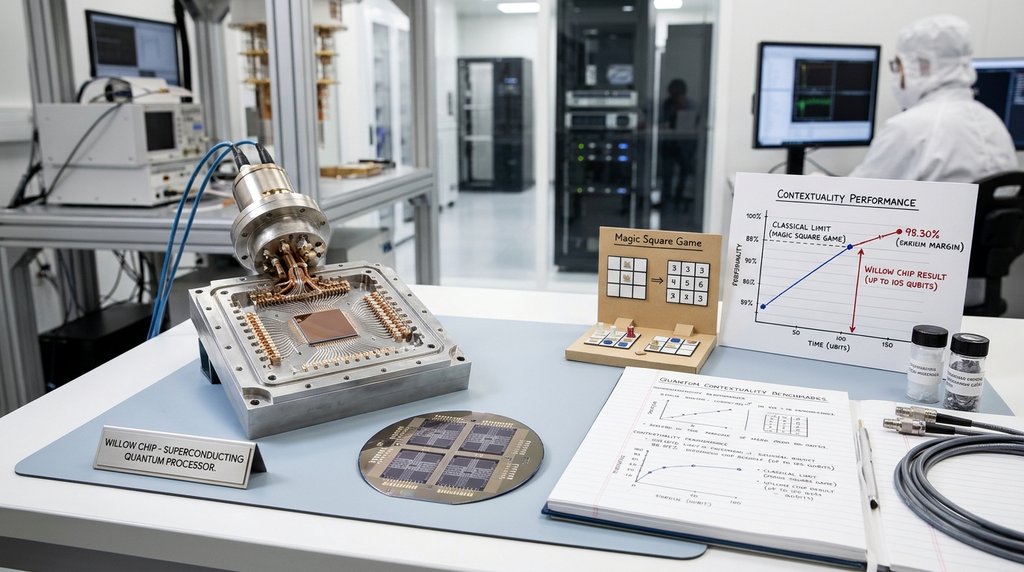
Google Quantum AI researchers have utilized their Willow superconducting processor to exceed classical computing limits in benchmark tests including the magic square game. The chip achieved a 98.30 percent win rate across 100,000 trials, well above the theoretical classical ceiling of 88.89 percent, and maintained contextual advantages up to 105 qubits.
Researchers Shashwat Kumar and Rodrigo Cortiñas at Google Quantum AI have demonstrated quantum contextuality on the Willow superconducting quantum processor, outperforming classical computational limits in structured benchmark experiments. In tests running the magic square game, a nonlocality and contextuality benchmark with a mathematically fixed classical winning limit of 88.89 percent, the Willow processor reached a 98.30 percent win rate across 100,000 trials with an error margin of plus or minus 0.01 percent. This represents a 9.41 percentage point improvement over classical limits, reducing the failure rate by roughly 6.5 times from 11.11 percent to 1.70 percent on physical hardware.
Quantum contextuality refers to the quantum mechanical principle where the outcome of a measurement depends on other compatible measurements performed alongside it, contrasting with classical assumptions that physical properties exist deterministically prior to observation. While contextuality has long been theorized as an essential resource powering quantum speedups, practical demonstrations have historically faced severe hurdles due to high gate error rates and limited coherence times in physical hardware. Previous quantum supremacy experiments largely relied on random circuit sampling, which sparked ongoing debates because classical algorithms could sometimes match or simulate the benchmark over time.
Beyond two-qubit magic square tests, Google expanded contextuality benchmarks to larger scales by running N-person GHZ parity games across three to 71 qubits and testing the Hidden Linear Function problem up to 105 qubits. Whereas classical win rates drop rapidly toward 0.5 as problem dimensions scale, the Willow processor continued to exceed classical boundaries across all 105 qubits by controlling crosstalk and preserving gate fidelity. Demonstrating that hardware can reliably access quantum contextuality provides a mathematically unambiguous benchmark that helps researchers evaluate the architectural efficiency and physical qubit overhead needed for future fault-tolerant quantum computers.
— AIDEN Editorial Team
What this means for the market
By surpassing mathematically fixed classical limits rather than relying on contentious sampling tasks, this achievement gives the global tech industry a more definitive standard for measuring real quantum computational advantage. As quantum processors expand past 100 qubits without suffering fatal decoherence, enterprise developers and cloud providers can better gauge the engineering timelines for fault-tolerant architectures. The milestone also offers policymakers and research consortia an objective benchmark to evaluate public and private investments in quantum hardware.
How this issue is unfolding
One foundational reason quantum computing outpaces classical computing lies in quantum contextuality, where the state of an observed quantity depends on the measurement context. Earlier demonstrations remained confined to theoretical paradoxes or small-scale proofs of concept, as superconducting hardware struggled to control gate error rates on larger processors. Using the improved coherence and gate precision of the Willow chip, Google presented empirical results exceeding classical boundaries in tasks like the magic square game and benchmarks scaling up to 105 qubits. Amid academic debates over quantum supremacy, this milestone is viewed as proving mathematical boundaries that classical architectures physically cannot reach, moving beyond random circuit sampling.