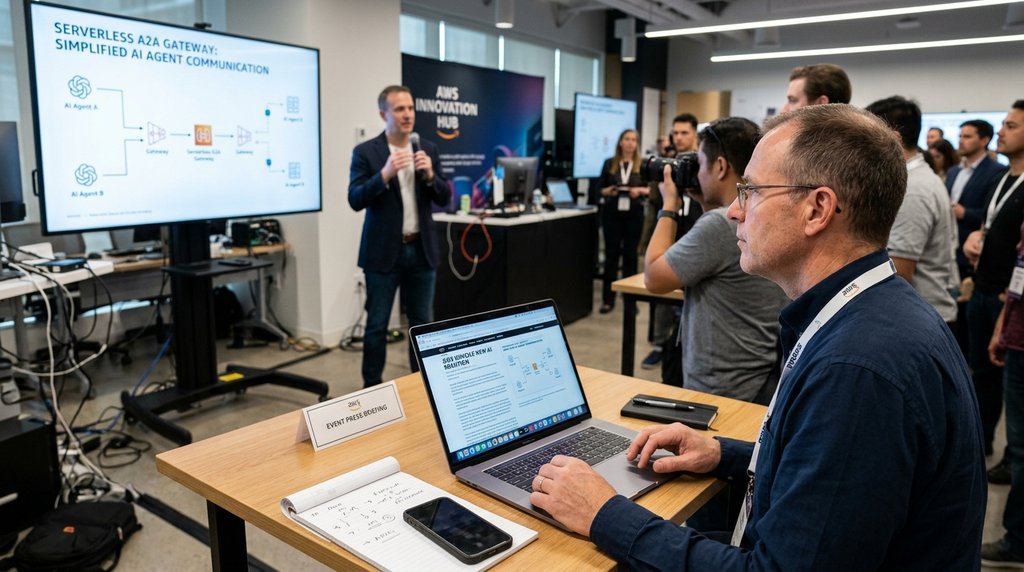
Amazon Web Services (AWS) has released detailed guidance on how to construct a serverless Agent-to-Agent (A2A) gateway, designed to streamline and secure communication among AI agents deployed across various enterprise environments. This solution aims to centralize agent discovery, routing, and access control, addressing the growing operational complexities that arise as organizations integrate more AI agents. The proposed architecture leverages AWS services such as Amazon API Gateway and AWS Lambda, providing a unified entry point for agents regardless of their underlying runtime, which could include Amazon Elastic Container Service (Amazon ECS), AWS Lambda, Amazon Bedrock AgentCore Runtime, or even non-AWS and hybrid cloud setups. The gateway is structured into three distinct layers: a Management layer for centralized agent registry and semantic search, a Control layer for fine-grained access control using JSON Web Token (JWT) scopes and a Lambda authorizer, and an Execution layer supporting single-domain routing with OAuth backend authentication and Server-Sent Events (SSE) streaming.
The increasing deployment of AI agents across teams, vendors, and diverse infrastructure presents a significant operational burden for enterprises. Without a centralized communication layer, each new agent integration necessitates custom point-to-point connections, separate credentials, and bespoke routing logic. This fragmented approach diverts engineering resources from developing core agent capabilities to managing connectivity, leading to slower time-to-market for new agent workflows. Furthermore, inconsistent authentication policies across a distributed network of agents elevate security risks and create operational overhead that scales quadratically with each additional agent. The gateway pattern, by establishing a single entry point, effectively mitigates these challenges by standardizing how agents communicate through the A2A protocol and centrally enforcing permissions. For instance, a deployment of twenty agents without a central orchestrator could require up to 190 individual point-to-point connections, a complexity that the gateway pattern is designed to eliminate.
This serverless A2A gateway offers substantial implications for enterprises, developers, and the broader AI industry. For businesses, it promises accelerated deployment of new AI agent workflows, enhanced security through consistent and centralized access control policies, and a significant reduction in operational overhead associated with managing complex agent networks. Developers can benefit by focusing their efforts on innovating agent functionalities rather than grappling with intricate connectivity issues, as standard A2A clients can integrate without modification. By providing a robust, scalable, and secure infrastructure for inter-agent communication, this AWS offering is poised to foster the development of more sophisticated and interconnected AI agent ecosystems. It represents a crucial step towards enabling the widespread adoption and seamless integration of AI agents into diverse enterprise operations, supporting real-time interactions and complex collaborative AI systems.