Apple controls half of top S&P 500 consumer revenue, Asymco finds
Hacker News|AIDEN Editorial|Nov 01, 2026
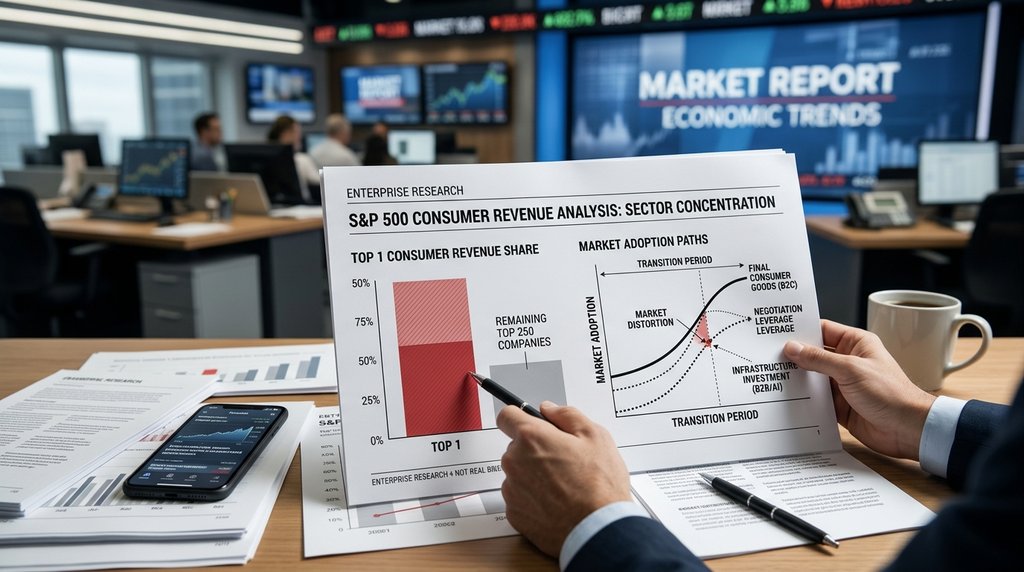
Apple commands more than half of all consumer revenue generated by the top 250 companies in the S&P 500, according to an analysis by market research platform Asymco. As Big Tech rivals pivot their capital expenditures toward B2B artificial intelligence infrastructure, Apple remains the lone mega-cap firm with direct access to consumer spending. This concentration could grant the company unprecedented leverage over software developers as AI applications move toward consumer monetization.
A sharp pivot toward generative artificial intelligence infrastructure and enterprise cloud hardware has produced an acute concentration of consumer spending power in the United States equity market. According to an analysis published on November 1, 2026, by Asymco founder Horace Dediu, Apple now accounts for more than 50% of the aggregate consumer revenue generated across the top 250 firms in the S&P 500. While peers including Nvidia, Microsoft, and Alphabet unit Google have reconfigured their operations around enterprise data center graphics processing units and large language model delivery, Apple stands largely alone among mega-cap firms in extracting high-margin revenue directly from individual consumers through premium personal hardware and integrated subscription services.
This structural divergence comes despite aggressive regulatory scrutiny directed at platform gatekeepers, including enforcement under the European Union Digital Markets Act and antitrust actions in the United States. While generative AI investments circulate hundreds of billions of dollars through server racks and enterprise systems, reaching end consumers still requires navigating Apple installed base of more than two billion active devices. In his assessment, Dediu weighted corporate figures toward margin contribution rather than gross transactional volumes, highlighting Apple trailing 12-month net profit margin of around 28% against the approximately 3% retail net margin typical of broad platforms such as Amazon. Dediu noted that all other top-half S&P 500 consumer sales combined fail to match the economic value captured by Apple, signaling a dwindling pool of public market exposure to direct retail consumption.
The methodology has provoked debate across market communities such as Hacker News, where critics argued that classifying suppliers such as Nvidia and Advanced Micro Devices as enterprise-only obscures their ongoing hardware sales to gamers and personal computing users. Observers also questioned whether downplaying Amazon immense retail footprint on the basis of low margins unfairly amplifies Apple relative dominance. Nonetheless, the structural bottleneck poses pressing challenges for software makers over the coming six months. As hyperscalers seek consumer returns on their massive infrastructure outlays, developers attempting to monetize consumer AI applications face heightened dependence on Apple app distribution rules and platform commission terms.
— AIDEN Editorial Team
What this means for the market
The heavy concentration of consumer monetization inside Apple ecosystem creates a strategic dilemma for generative AI developers worldwide. While hyperscalers are investing historic sums into compute infrastructure, their ability to recover that capital through consumer-facing software remains constrained by Apple control over app store distribution and fees. As global software companies transition from enterprise experimentation to end-user monetization, regulatory focus may inevitably shift toward pricing leverage and revenue-sharing terms imposed by the sole dominant consumer gatekeeper.
How this issue is unfolding
As major technology firms including Nvidia, Microsoft, and Google have shifted their core operational focus toward AI data centers and enterprise cloud infrastructure, direct consumer touchpoints across public equity markets have contracted rapidly. In contrast, Apple has preserved a distinct structure that taps directly into consumer spending through an active device base exceeding two billion units, high-margin hardware, and recurring subscription services. The Asymco analysis indicates that while capital markets are heavily skewed toward revolving enterprise capital expenditures among AI hyperscalers, Apple has emerged as virtually the sole top-tier public company generating tangible cash flow in the end-consumer market. This dynamic implies that as the AI software ecosystem advances toward consumer-facing monetization, Apple negotiating leverage could expand significantly as the primary stable consumer gateway.