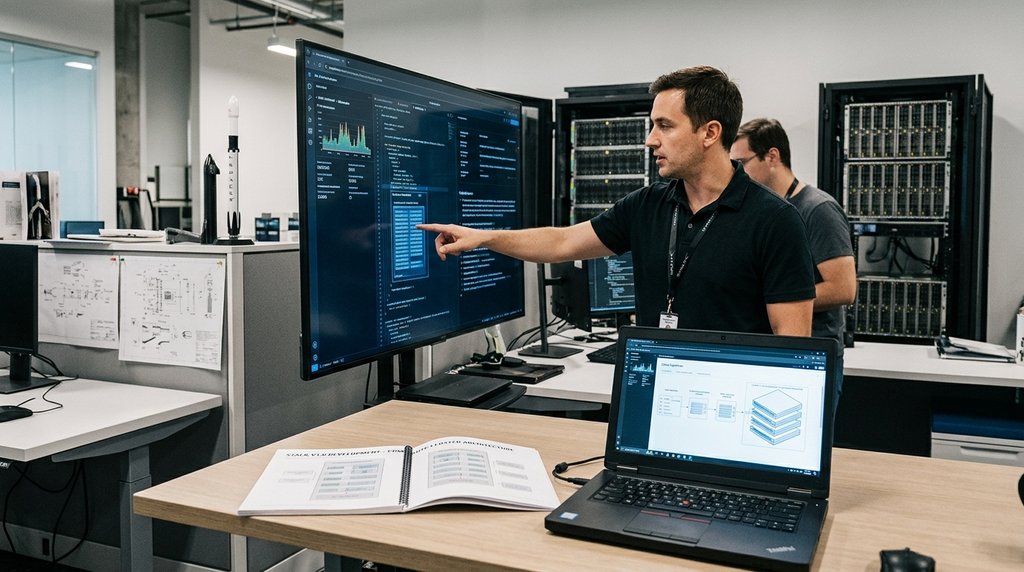
Elon Musk recently revealed on X.com that SpaceX is nearing the completion of version 1.0 of its proprietary AI training stack. This in-house software, developed in C, is engineered to precisely map to a colossal cluster of 220,000 Nvidia GB300 GPUs, utilizing 800G network interface cards (NICs). The design emphasizes heavy use of pipeline parallelism and aims to achieve performance as close to bare metal as possible, promising significant speed improvements over existing frameworks like JAX for large-scale training runs. This initiative underscores a strategic move by SpaceX to build highly specialized infrastructure tailored to its specific AI computational needs.
The development of custom AI training stacks represents a growing trend among major technology companies seeking to maximize efficiency and control over their computational resources. As AI models grow exponentially in size and complexity, the demand for optimized hardware and software integration becomes paramount. Achieving bare-metal performance and employing advanced techniques like pipeline parallelism are critical for reducing training times and costs associated with massive GPU clusters. This approach allows companies to bypass the overhead of general-purpose frameworks, extracting every ounce of performance from their underlying hardware, a strategy also pursued by other industry giants investing in custom silicon and software solutions.
This move by SpaceX highlights a broader industry shift towards vertical integration in AI infrastructure, where companies are not just consuming off-the-shelf solutions but are actively engineering their entire compute stack. For the global AI industry, this signifies an acceleration in the race for computational efficiency, potentially leading to faster development cycles for advanced AI models. Developers might see new paradigms emerge for optimizing large models, while enterprises could face increased pressure to invest in specialized infrastructure expertise. Ultimately, such bespoke solutions could further concentrate AI capabilities among a few well-resourced entities, influencing the competitive landscape and potentially raising questions for policymakers regarding access and innovation.