Google Research unveils VERID digital twin framework for autonomous wet labs
Google Research|AIDEN Editorial|Oct 16, 2026
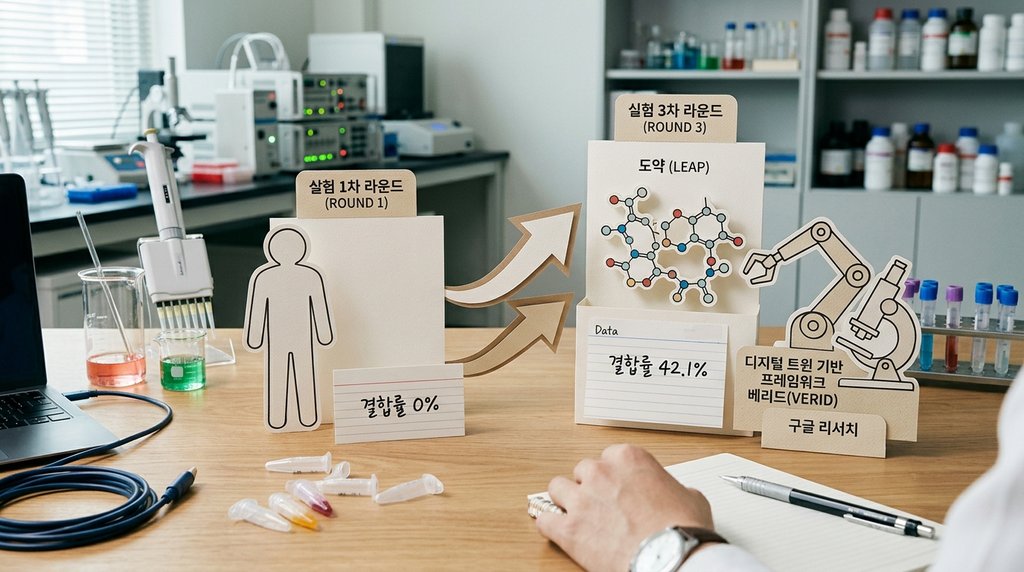
Google Research has introduced VERID, a digital twin framework designed to connect artificial intelligence agents safely with physical wet lab automation. By pre-simulating robotic instructions, the closed-loop system drove target binding rates in aptamer experiments from 0% to 42.1%.
Google Research scientists Pooja Rao, Petar Sirkovic, and Annalisa Pawlosky have unveiled VERID, short for VERified Infrastructure for Discovery Laboratories, an open-source framework built on PyLabRobot. While biological artificial intelligence models such as AlphaFold have advanced in silico simulations, large language model agents operating in the physical world frequently face spatial reasoning and volume calculation errors that risk equipment collisions or reagent contamination. VERID addresses this gap by creating an exact digital twin of physical workbenches, establishing a software-level validation layer that intercepts and tests machine instructions before any code executes on automated liquid handlers.
The framework relies on four core safety controls: real-time three-dimensional tracking of the laboratory environment, full virtual pre-simulation run in seconds, hardware safety checks that operate like software type checkers to prevent collisions or invalid commands, and tightly synchronized video and telemetry logging. These protective layers enabled an autonomous closed-loop search targeting alpha-thrombin aptamers, where the system learned directly from negative data. While the initial round yielded zero hits across 167 candidates, the agent refined its molecular structures autonomously by round three, achieving a 42.1% binding success rate across 311 candidates alongside 98.5% target specificity.
Beyond safety validation, the researchers achieved significant computational savings by implementing an epitope-focused approach that targets specific binding pockets rather than folding entire protein structures. This method accelerated structural prediction speeds by roughly 8.6 times while generating drug candidates with single-digit nanomolar binding affinity. According to the research team, future biological agents should advance toward running experiments and resolving issues autonomously from operational feedback, provided that human scientists retain supervisory control to prevent physical hazards and costly reagent waste.
— AIDEN Editorial Team
What this means for the market
The introduction of verified digital twin layers marks a critical shift for the AI biotechnology sector by transforming autonomous wet labs from theoretical demonstrations into viable enterprise infrastructure. Reducing computational overhead via targeted pocket modeling while eliminating hardware collision risks lowers both cloud expenditure and operational barriers for research organizations. For developers and automated facility operators worldwide, establishing standardized safety intermediaries will be necessary to deploy agentic biological design systems at scale while maintaining rigorous safety standards.
How this issue is unfolding
Biological artificial intelligence research has advanced rapidly through in silico platforms such as AlphaFold, yet the speed gap between virtual simulation and physical wet-lab validation has remained a primary bottleneck. Large language model agents often struggle with three-dimensional spatial reasoning and volume calculations, posing risks of hardware damage and contamination when issuing commands to automated liquid handling equipment. By replicating laboratory benches within a real-time digital twin and enforcing pre-execution virtual checks similar to a software type checker, Google Research developed VERID to secure the physical control of laboratory automation. This milestone demonstrates that closed-loop autonomous laboratories, capable of refining molecular structures using real experimental feedback, are becoming practical for real-world research facilities. Nonetheless, persistent hazards including robotic miscalibration, biological containment, and bias-driven exploration paths ensure that human scientific supervision remains indispensable during protocol approval and final verification.